
A Landscape, Illustrated

How artist Ally Grant turned six weeks at Pierce Cedar Creek Institute into a colorful celebration of 25 years of people, place, and possibility.
When Ally Grant shared her illustrated history of Pierce Cedar Creek Institute with nearly 200 guests at the 25th Anniversary Gala, she wasn’t quite sure what to expect. She had spent six weeks researching, sketching, illustrating, and assembling a colorful little booklet that told the story of PCCI’s beginnings. On the reverse side, an intricate foldout map invited readers to explore the landscape through the plants, animals, and experiences that make this place special. But would people connect with it?
The answer came as guests began opening the pages. They recognized Bill Pierce and Doug DeCamp, the two entrepreneurs whose success with Flexfab helped make the Institute possible. They spotted Jessie Pierce and other familiar faces. They discovered little details tucked into the illustrations, each carrying a piece of the Institute’s history. And when they unfolded the map, some gasped.
“Just seeing their reaction was everything,” Ally recalled. “Just seeing them like their eyes widen when they open the first page, and they point out all of the different people in the story.”
For an artist just beginning her professional career, the experience was unforgettable. It was also the culmination of a journey that began years before she ever set foot at Pierce Cedar Creek Institute.
An Opportunity Worth Pursuing
Growing up in rural Alaska, Ally developed an early appreciation for nature. Forests, wildlife, snow, and even severe weather were familiar parts of her childhood. Art was equally important. As a young girl, she would stay up late with a flashlight, drawing animals and flowers from books about dinosaurs, natural history, and wildlife. That fascination with illustrating the natural world followed her into adulthood.
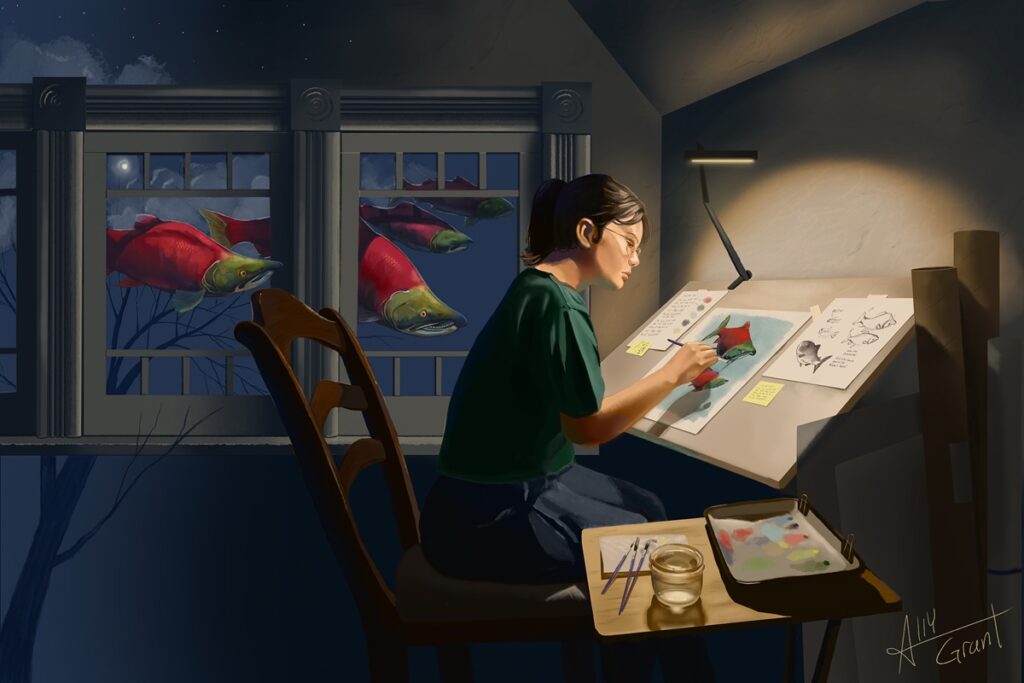
After moving to Michigan for college, Ally learned about PCCI’s Biological Field Station through Nancy Hart (Ally’s faculty mentor from Kendall College), who encouraged her to pursue its Creative Arts Fellowship. The opportunity captured her imagination. But Ally didn’t apply immediately. She wanted to develop her skills and feel confident that she could produce work worthy of the experience. When she eventually applied, she wasn’t selected. So she kept working. The following time, she was accepted.
“Coming here was like my drive and my focus,” Ally explained. “This was my passion to be accepted here at Pierce Cedar Creek.”
She still remembers walking through the Visitor Center doors for the first time as an accepted fellow. “Wow! I’m actually here.” What surprised her over the following weeks was how quickly the Institute began to feel like a place of belonging. For someone who had always found comfort in the wilderness, the building itself became an unexpected source of that same feeling. Shared meals, conversations with staff and researchers, and the everyday rhythm of the Institute helped her settle into a new community.
“I actually felt comfort within a building,” she reflected, attributing that feeling to the care people had invested in the place.
Six Weeks to Tell a 25-Year Story
Ally arrived with an ambitious plan. She wanted to illustrate two stories: one about the Institute’s history and another about the environmental education, research, and stewardship happening there today. She also hoped to create a new illustrated map. Her PCCI Creative Arts Fellowship faculty mentor, Matthew Schenk (Grand Rapids Community College), helped her recognize just how much work she was proposing. His advice was simple: concentrate on the history first, and see whether there was time for the map.
It was good advice.
Ally spent nearly eight hours a day working on the project, beginning with sketches and page layouts. She researched Flexfab, read historical articles, explored old newspapers through the Hastings library’s online collections, and repeatedly studied the 25th Anniversary timeline displayed in the Visitor Center. She also listened. Conversations with staff, volunteers, and people who had known the Pierce family brought the historical record to life. Those exchanges helped her discover details that might never have appeared in a conventional account of the Institute’s founding.
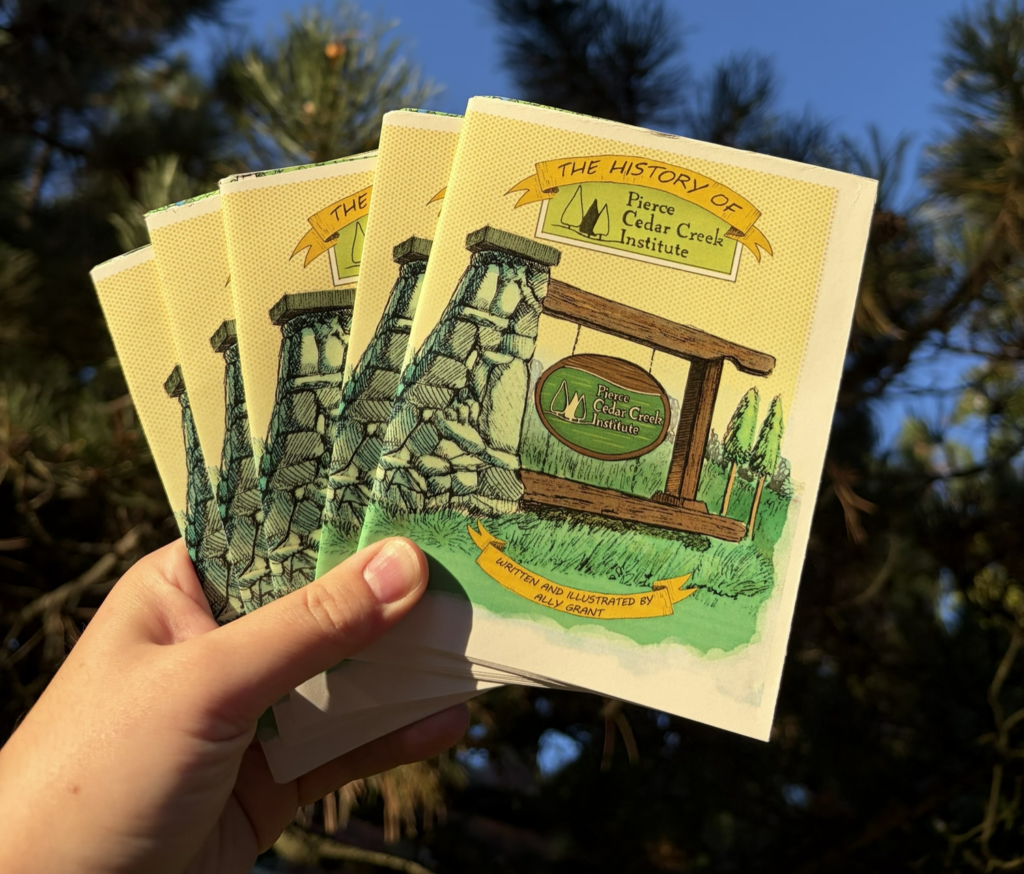
The result was a zine, short for mini-magazine, a small illustrated publication that could be folded, shared, and kept. Ally first encountered the format in an illustration club during her freshman year of college (at Kendall College). She loved the idea of creating something personal and accessible that could travel home with people. She had visited plenty of nature centers and parks where visitors received traditional brochures filled with information. She wanted to create something different, a story people would remember.
History Through an Artist’s Eyes
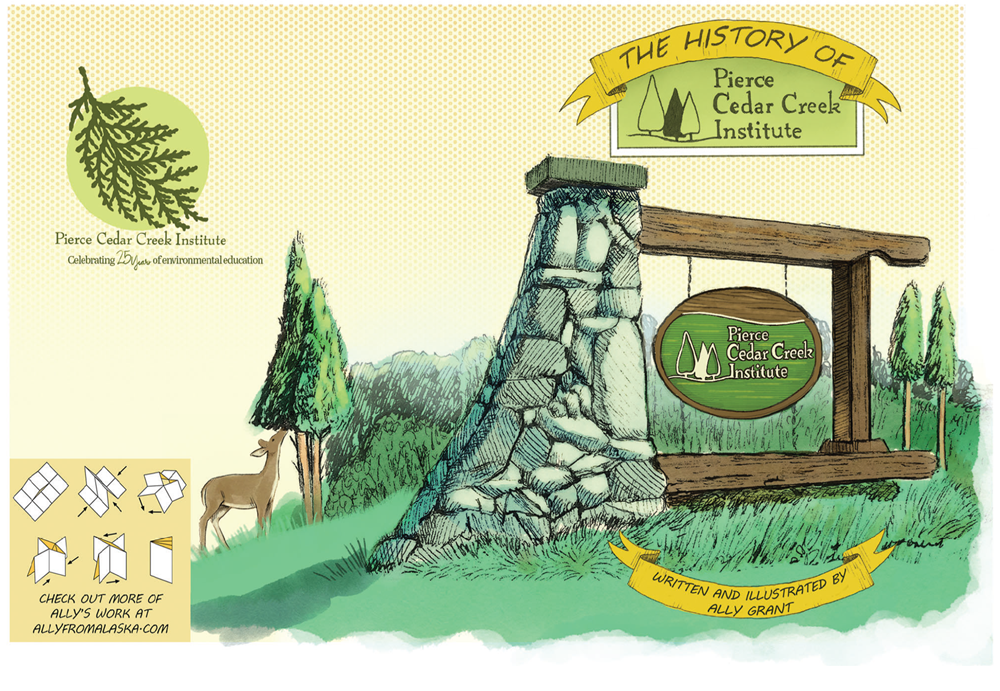
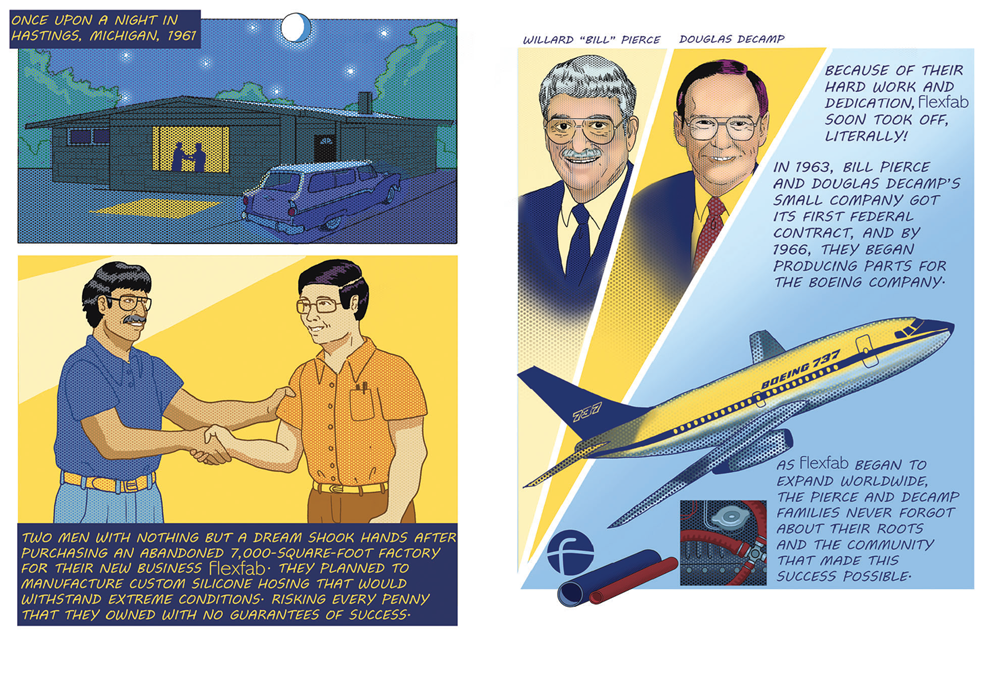
Ally’s illustrated history begins well before the Institute opened its doors in 2001. The first pages introduce Bill Pierce and Doug DeCamp, whose early entrepreneurial ambitions grew into Flexfab, a successful, global manufacturing company with deep roots in Barry County. In one illustration, the two men shake hands. In another, a Boeing airplane climbs across the page, recalling an important chapter in Flexfab’s growth. For Ally, the airplane also became a symbol of possibility: an idea that began with two people willing to take a chance and grew into something neither could have fully imagined.
Other illustrations explore the Pierce family’s commitment to the community and their vision for environmental education. One of Ally’s favorite scenes depicts Bill and Jessie Pierce sharing their hopes for the Institute with family and friends. There is no photograph documenting that precise conversation. Instead, Ally used historical research and her imagination to interpret what such a gathering might have looked like.
“There’s a lot of really important moments in our life that aren’t really documented visually,” she explained.
Bringing those moments to life is part of what she loves about illustration
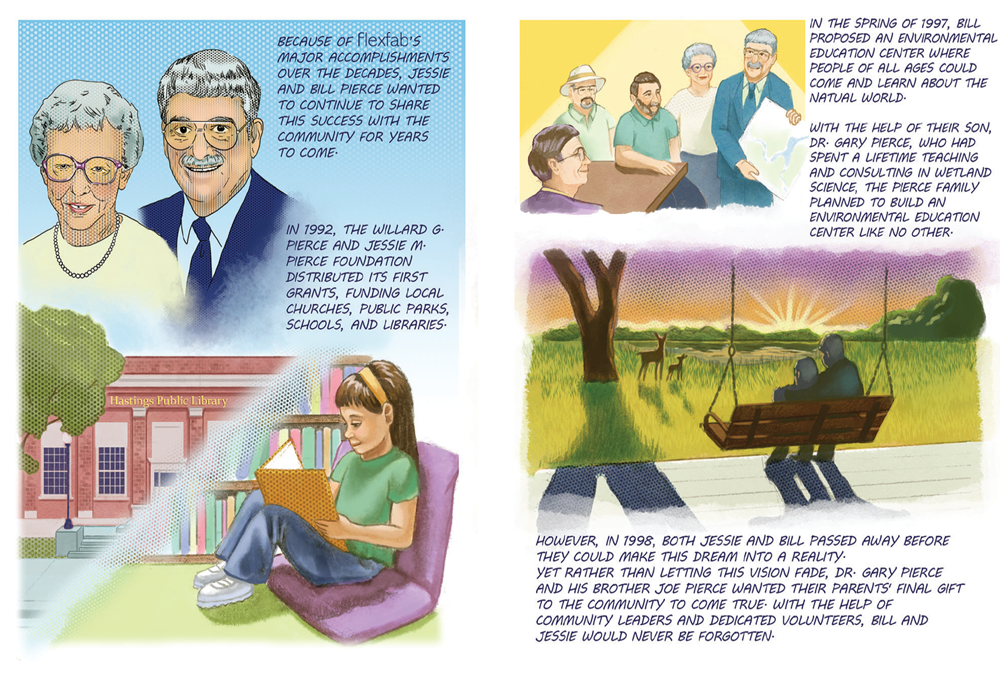
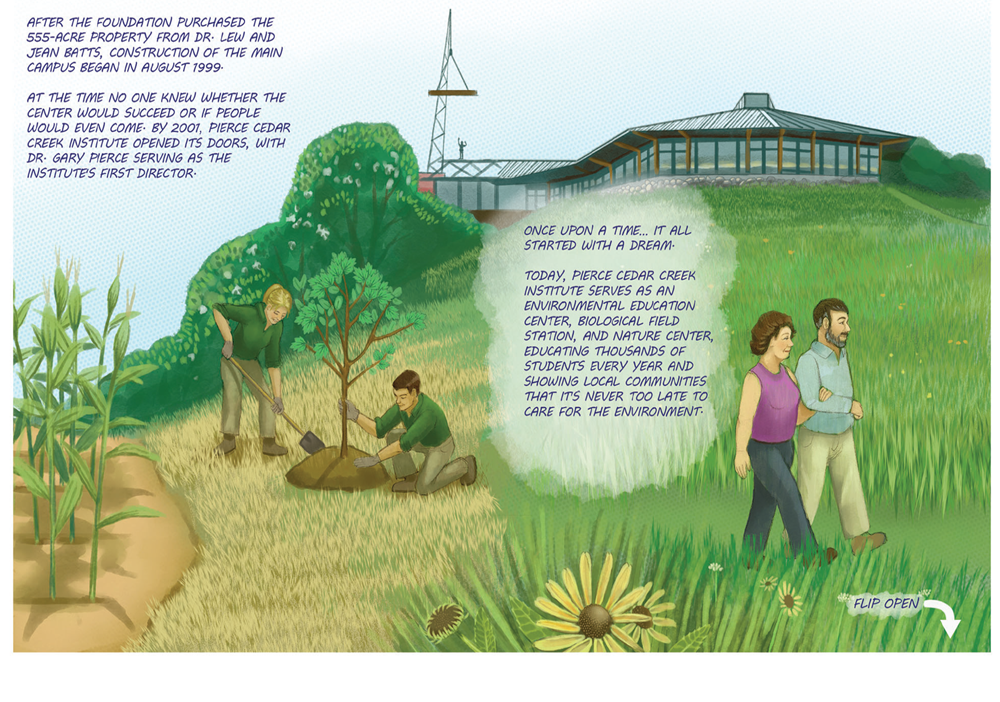
Other details emerged directly from her time at PCCI. Mary and Gary Pierce appear walking together along a trail, inspired by stories Ally heard about their hikes through the property. The booklet’s final pages show people planting a young sycamore tree, a quiet reference to the tree the Institute planned to plant in honor of longtime staff member Sara Syswerda. Even the deer near the entrance sign on the cover carries a little piece of PCCI’s recent history, recalling conversations about deer chomping on the landscaping. Each illustration became an opportunity to weave together documented history, personal memories, and the everyday experiences of people connected to the Institute.
A Map Full of Hidden Stories
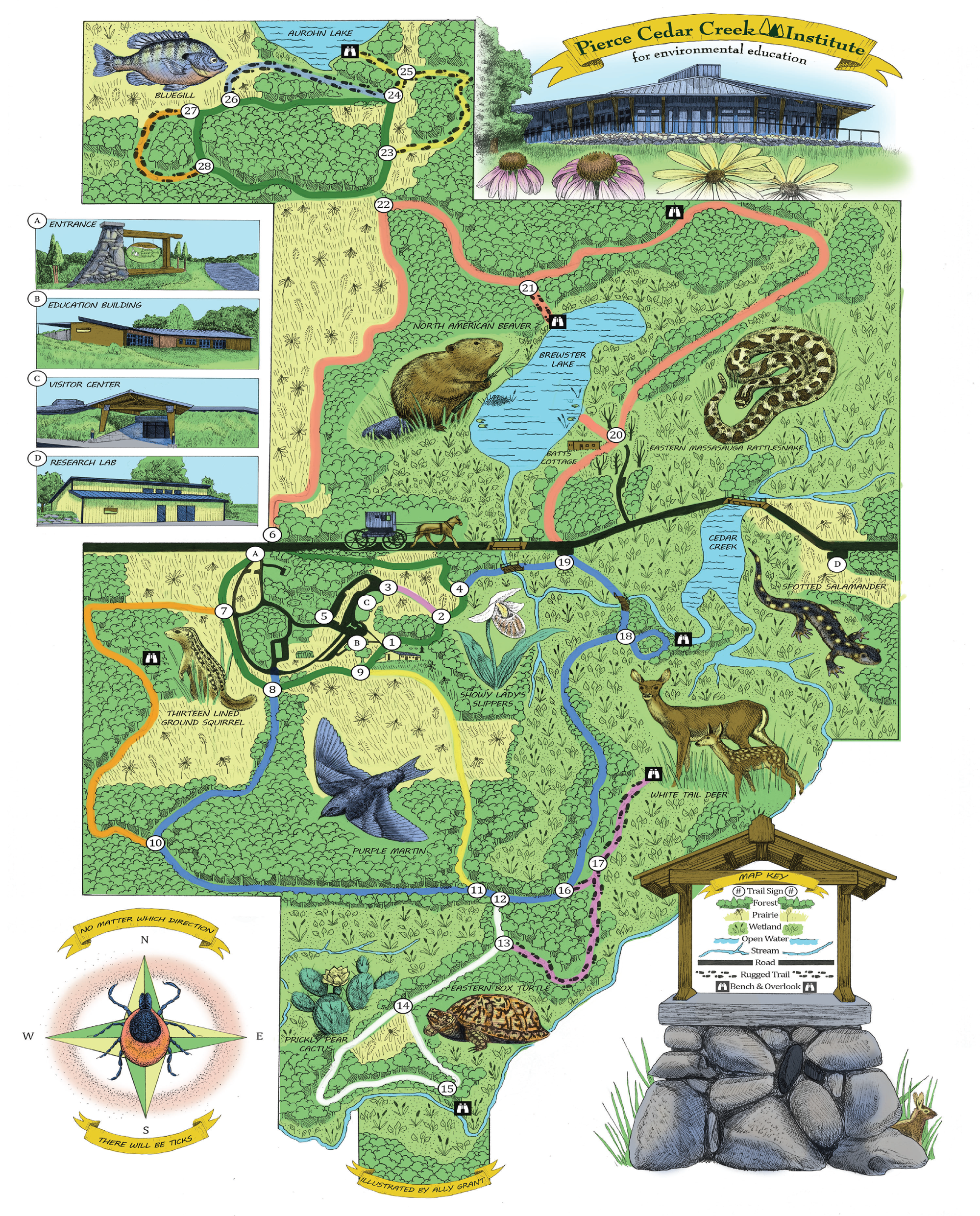
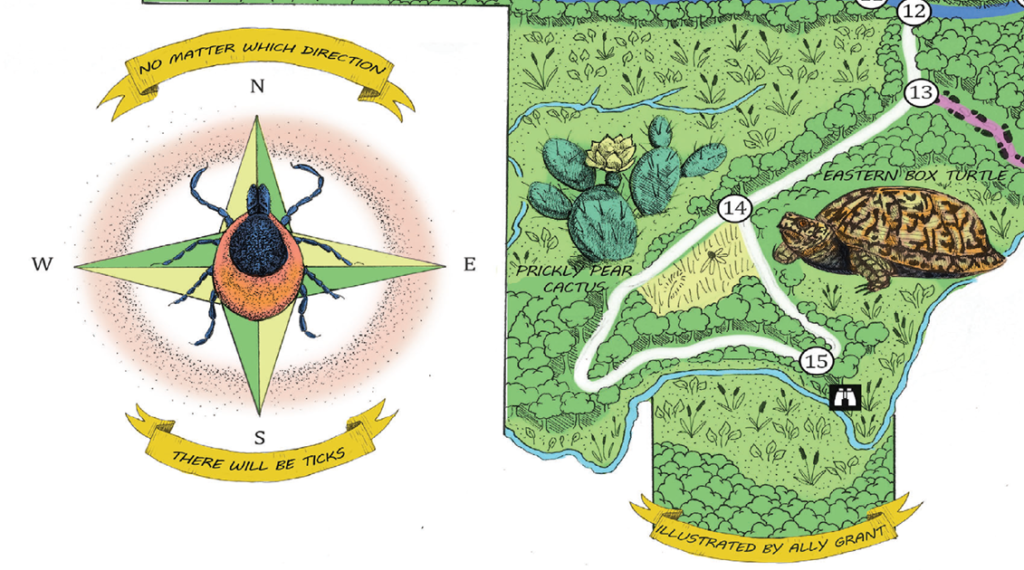
If the illustrated history tells readers where Pierce Cedar Creek Institute came from, Ally’s map invites them to discover what makes it special today. Unfolding the booklet reveals a colorful landscape filled with familiar places and wildlife. There are purple martins, beavers, rabbits, deer, lady slippers, box turtles, prickly pear cactus, and the eastern massasauga rattlesnake. Small details celebrate the sights and experiences that visitors might encounter while exploring the property.
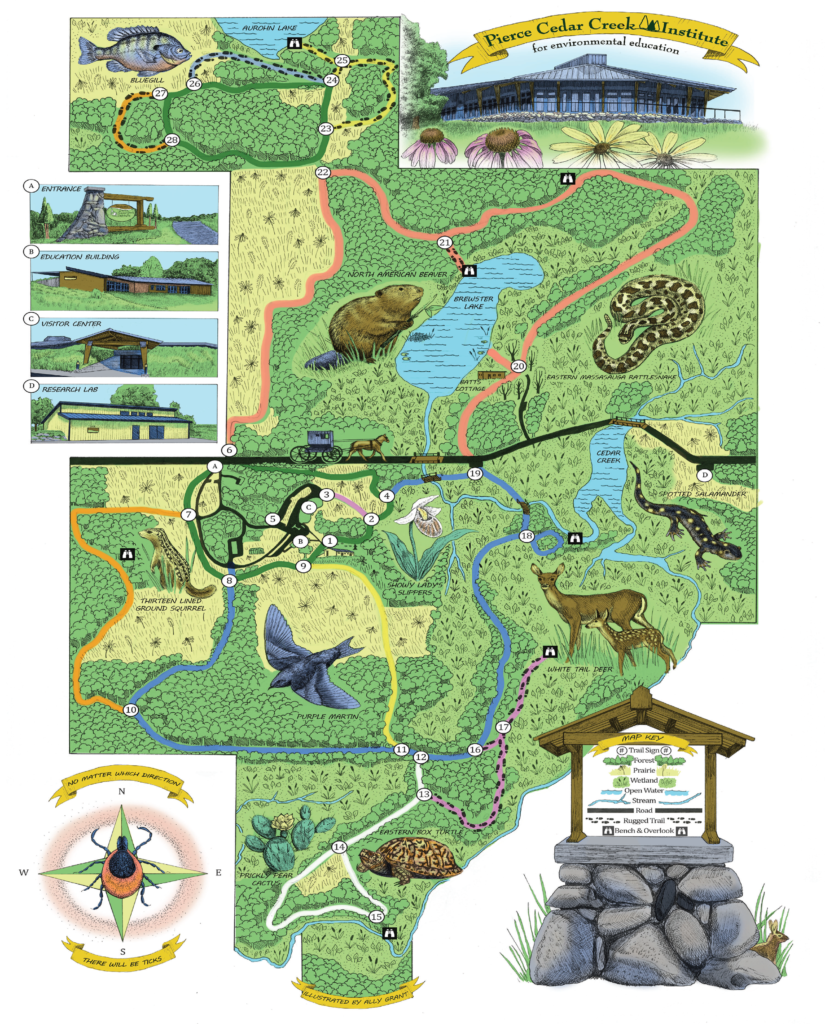
Unlike a zoo map, where visitors can follow a path to a particular animal exhibit, a nature preserve offers no guarantees. A beaver may be working near its lodge. A turtle may be crossing a trail. A rare flower may bloom quietly beside a wetland. Part of the joy is discovering what happens to be there. Ally wanted her map to provide a sense of orientation while encouraging visitors to look more closely.
Many illustrations grew from her own observations during the residency. She remembers watching the Steeby Natural Resource Fellows lower the purple martin houses to monitor nesting birds. The routine became something she looked forward to, especially as she watched eggs develop and young birds grow. At Brewster Lake, an enormous beaver lodge caught her attention. The rabbits and ground squirrels around the Education Building became familiar companions during long days of illustrating.
And then there is the tick.
Ally incorporated a blacklegged tick warning into the map’s compass, a humorous but practical reminder that ticks can be encountered in any direction. Having grown up in Alaska, where ticks were unfamiliar to her, she found Michigan’s tick population particularly memorable. A family outing that ended with an unexpected tick inspection only reinforced her determination to include the warning. These playful details give the map personality, but they also reflect something important about Ally’s artistic approach. She wasn’t simply drawing a landscape from above. She was drawing the place as she had come to know it.
Seeing the People Behind the Place
Over six weeks, Ally began to understand something that isn’t always obvious to a visitor walking through the doors. An Institute like PCCI depends on an enormous amount of care. There are researchers collecting data, land stewards restoring habitats, educators working with students, volunteers lending their time, donors supporting programs, and staff handling countless details that make the visitor experience possible. Seeing that work firsthand changed the way Ally thought about nature centers and preserves.
“To actually be involved with that experience, to actually see what goes on with the day-to-day work, it’s like a whole other world,” she said.
Her artwork began to reflect that understanding. When she shared the finished booklet with the PCCI community, she was especially moved by the responses of longtime volunteers and supporters. Some had been involved with the Institute for decades. They had helped build programs, cared for the property, supported its mission, and watched it grow. Now they were seeing familiar faces and memories reflected in a young artist’s interpretation of their shared history.
For Ally, their reactions made the long days and countless revisions worthwhile. They also gave her something she hadn’t expected: confidence.
“I can do this as a career,” she remembered thinking after the presentation. The experience encouraged her to begin reaching out to other nature centers and preserves, sharing the possibility of using illustration to tell their stories.
And the history she had spent the summer researching offered its own lesson. Bill and Jessie Pierce had imagined an environmental education center without knowing exactly what it would become or whether people would come. Ally had undertaken an ambitious artistic project without knowing how people would respond.
“If Bill and Jessie could do it, I could do it,” she told herself.

A Gift That Keeps Telling Its Story
Copies of Ally’s illustrated booklet were shared with guests at PCCI’s 25th Anniversary Gala in August, giving friends and supporters a keepsake from a year devoted to remembering the Institute’s beginnings and celebrating its future. But the story doesn’t end with the anniversary. Ally hopes that someone who discovers her booklet years from now will recognize the dedication that sustained PCCI through its first 25 years and continues to shape the Institute today.
She also hopes to keep growing as an artist. When asked what she might create for the Institute’s 50th Anniversary, she laughed and imagined returning with another 25 years of experience. Perhaps next time, she suggested, it could be a 30-page graphic novel. And maybe she’d even get seven weeks to finish it.
For now, her illustrated history and map offer something worth holding onto. They remind us that a place can be understood through many different eyes: those of a scientist, a land steward, a visitor, a volunteer, or an artist willing to spend six weeks paying close attention. Ally came to Pierce Cedar Creek Institute hoping to create something meaningful. She left with greater confidence in her own abilities, a deeper appreciation for the people who care for the land, and an invitation to return for the next big anniversary.
And PCCI received a gift that will continue telling its story long after the celebrations of 2026 have ended.
Thank you, Ally. We can’t wait to collab on the 50th Anniversary.
Stop by the Visitor Center to Explore the Story for Yourself
Stop by the Pierce Cedar Creek Institute Visitor Center to discover Ally Grant’s illustrated history and map. Take a closer look at the people, wildlife, and little details that make this place so special.